Is there a better time to contemplate freedom than Remembrance Day during a global pandemic? I don’t know. Much opinion has recently been offered on the state of our freedom. It seems prudent that, as we navigate these turbulent times, it is worth taking pause to assess the status of our freedom at some regular interval.
I have not known a time in my life when I have faced government restrictions on my actions the way I do now. There are strict public health protocols all around us and more are coming. Many of them dictate behaviour that makes us uncomfortable in myriad ways. Furthermore, it is clear that conformity to those protocols runs on a sliding scale. On the horizon is the looming prospect of a vaccine for COVID-19. When we think with an open mind, it is possible to consider how a vaccine could be just as much a threat as a gift. If the only way to secure one’s livelihood is to accept the injection of foreign materials into your person then, for many, informed and genuine consent is not an option and vaccination becomes coercion. Should we not ask: what’s next and where does such a policy lead society? Coercion is not freedom.
Nonetheless, my freedoms abound. I face few obstacles to my freedom, if any, in my day to day living. Coming and going from a career of my choosing. Electing to keep my children out of a troubled and jumbled education system. Traveling around my community, to grocery stores, parks, and flu shot clinics with my own agenda and timeline. Surely the sum of these privileges amount to evidence that I live freely.
Curiously, this year, Remembrance Day for me fell between two evenings of professional development focused on anti oppression and anti racism. Free as I may be, it is clear that freedom is not equally distributed among all people and, if we are truthful historians, never has been. At the learning event on the evening before Remembrance Day, a colleague asked: how do we decolonize Remembrance Day? My first reaction was that I prefer the colonized Remembrance Day and the freedoms it affords me. But my conscience had been unsettled. Why are our remembrances encapsulated in the time frame that includes the First World War to present day? We remember World War Two – although actual lived experience won’t be around much longer. We remember the Korean War, the Gulf War, the Kosovo War, and the Afghan War. The go forward date on Remembrance Day is justifiably open ended and should remain so as long as we humans perpetuate violence against one another. And yet our remembrances are culturally retroactive only to a point? In fact, violence and war was in full swing in North America well before the events that precipitated World War One. Violence that, by today’s standards, would unequivocally amount to war crimes.
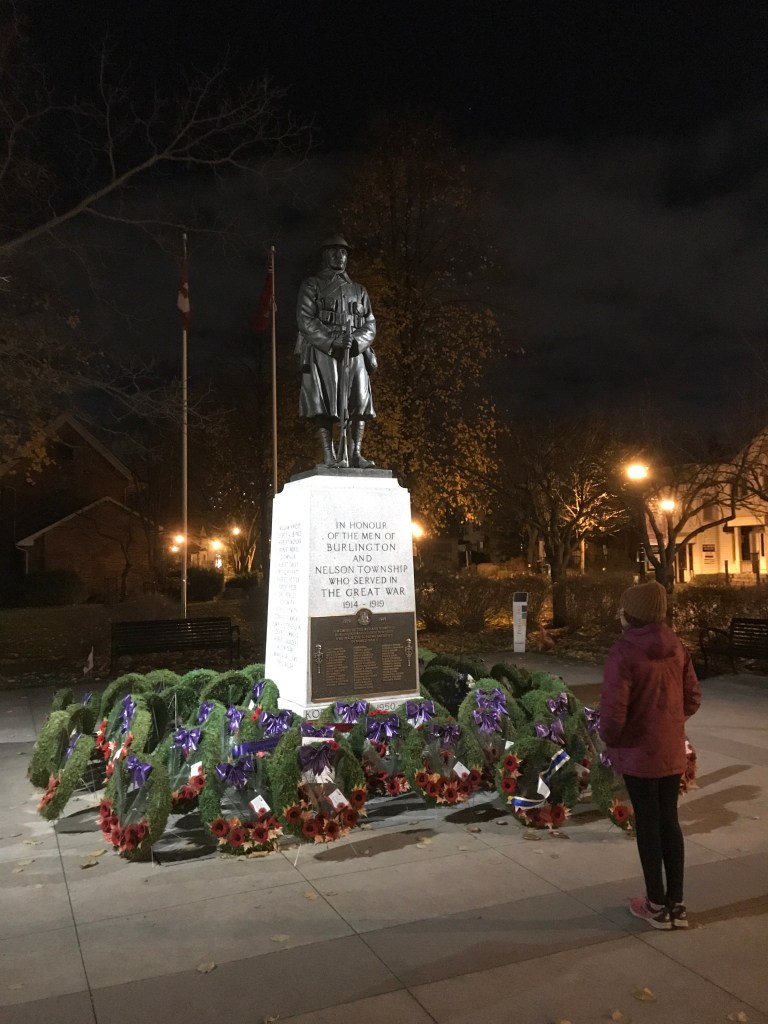
Because I was at the learning event, I missed my regular Tuesday night walk with Ruby. We have been venturing out, without fear for our safety or worry of breaking curfew for the past six weeks on brisk fall walks where spiders and waves and crisp leaves and skunks cross our paths. We talk about books and The Mandalorian and theatre class and guitar lessons. Usually she helps me unpack a problem I am trying to solve at work. Delightfully, we are getting to know all the oldest trees in the neighbourhood. Which is to say that this week we went walking on Wednesday instead of Tuesday and Wednesday was Remembrance Day.
The red oak we discovered this Wednesday night was at least 200 years old. Quite possibly 250. Perhaps with a third person, we could have encircled it completely. With just the two of us there, it had to settle for a partial hug.
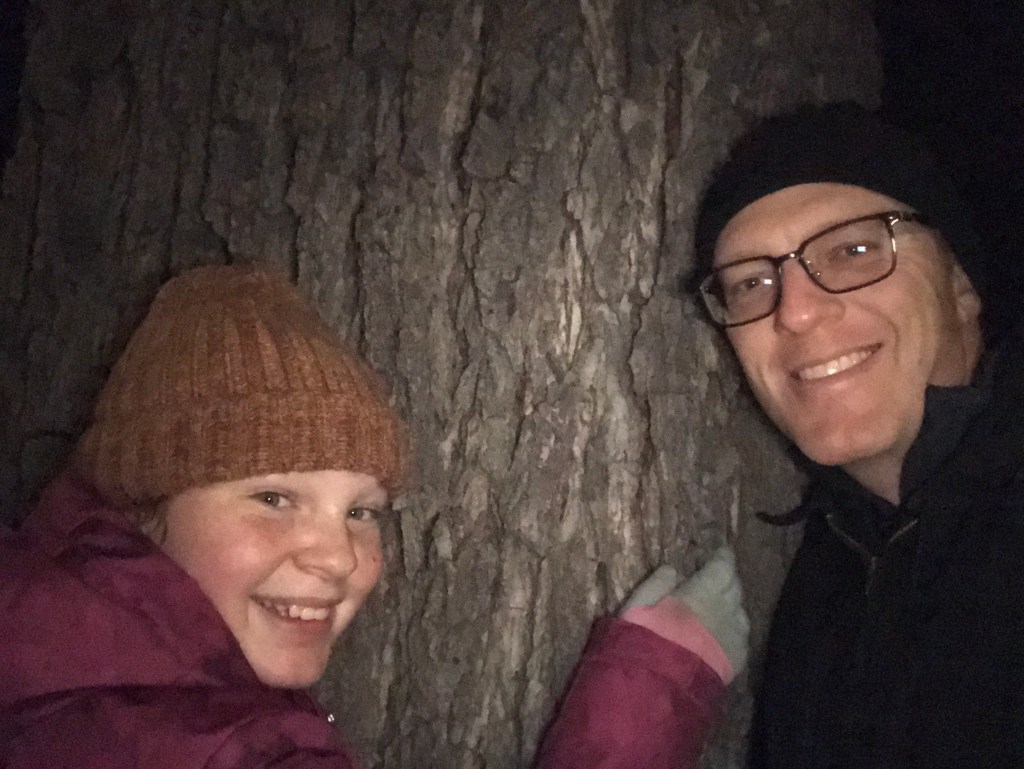
Ruby is completely enamoured with musical theatre and was quick to calculate that this tree was likely alive during the days of Alexander Hamilton. In his time, Hamilton had a few things to say about freedoms. Consider also that enslaved Black people shared a timeline with this tree. So did Louis Riel, Leader of the Red River and North-West Rebellions. Riel was executed for high treason by his own government and many others who identified with him as uniquely free peoples were also killed. This tree was alive during the American Civil War. The October Crisis. Ipperwash. All battles rooted in a commitment to freedom. Where do these events fit in our cultural discussion of Remembrance Day? Whose freedom do we prioritize? Whose sacrifices do we choose to remember?
To be sure, There are many possible answers to these questions. If attending school Remembrance Day services for the past 40 years has taught me anything, its that freedom requires sacrifice. I do not wish to discredit or devalue any of the sacrifices that were made on my behalf. Lives were lost in order to clear a path for my blissful existence and I am full of gratitude. Likewise, I am full of awe and admiration for the women and men who stand at the ready to protect my and my children’s freedom should it become endangered.
I do think that, in this time when we are being asked to curb our actions, we would do well to broaden our conception of remembrance and to consider, in our hearts and minds, the extreme removal of freedom that was experienced by humans just a short time ago. Were the sacrifices made by soldiers since the so called “enlightenment” intended for the preservation of freedom for a certain segment of society, or were those sacrifices made with love and hope such that freedom would be a privilege extended to all Humans?

 3 Ginger Snaps
Thanks for your reflections Drew and Ruby. What a cool tradition you two have. Keep sharing life together. Miss you guys and look forward to the freedom to see you 5 again!
LikeLike
Very thoughtful Drew.
LikeLike